Send us one name. We’ll find them in the old records.
- Death certificates for Santi (1980), Rosa (1983) and Lillian (2002)
Next search: Order death certificates for Santi Paolini (died 05/05/1980, Merced County), Rosa Paolini (died 08/04/1983, Merced County) and Lillian V. Knudsen (died 24 October 2002, last residence Modesto, Stanislaus County). They give birthplace, parents’ names, spouse, and the informant. — Merced County and Stanislaus County Clerk-Recorders, or CDPH Vital Records - Santi’s family in Montuolo
Next search: Italian civil birth registers begin in 1866. Look for Santi’s birth on 3 January 1891 (or 1890) in the civil registration of the comune of Lucca; the entry will name his parents, and from there the family can be traced back. — FamilySearch — ‘Italia, Lucca, Stato Civile (Tribunale)’ and Antenati (antenati.cultura.gov.it), the Italian State Archives’ free portal - Rosa’s family in Grumento Nova
Next search: Rosa Giannone (Gianone), born about August 1890 in Grumento Nova; her death record gives her mother’s surname as Alberti. Until 1932 the town was called Saponara (Saponara di Grumento), so the 1889–1891 birth registers are filed under that name. — Antenati (antenati.cultura.gov.it), Archivio di Stato di Potenza registers
What’s still unknown, and where to look
- When and how did Santi Paolini arrive in America (Ellis Island)?
The 1920 census gives his arrival year as 1907. The 30 March 1907 Konig Albert manifest (page 59, line 17) is worth checking with your own eyes…
Lillian Velda Paolini (later Hamilton, later Knudsen)
A sourced family-history report · prepared 9 October 2026
Lillian Velda Paolini was born on 26 December 1919 in Los Banos, in California’s Merced County, the youngest daughter of Santi Paolini and Rosa Giannone. Her own Social Security application, filed in September 1939, names them as her parents.1,2,3,4
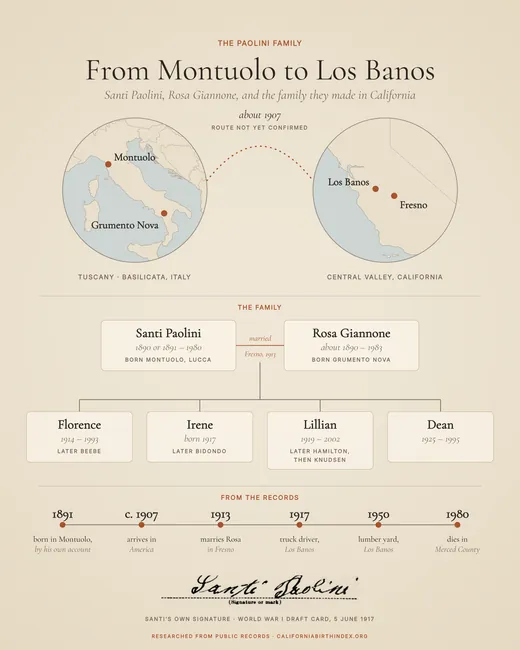
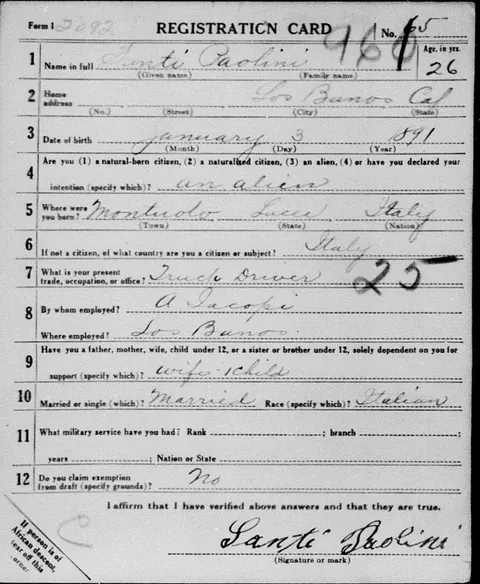
Santi was born in Montuolo, a small place just outside the city of Lucca, in Tuscany. We know because he said so himself. When he registered for the World War I draft in Los Banos on 5 June 1917, the card asked “Where were you born?” and the answer written there is “Montuolo, Lucca, Italy.” He gave his birth date as 3 January 1891; three later records say 1890. He was 26, married, still an Italian citizen, and driving a truck for A. Iacopi in Los Banos, with a wife and one child depending on him. The registrar described him as tall and stout, with dark grey eyes and black hair. He signed the card himself.5,6,7,8
The 1920 census says he came to the United States in 1907, when he was about sixteen. We have not yet confirmed how he travelled. One possible arrival fits his age and the year: a 17-year-old Paolini who landed at Ellis Island from Genoa on 30 March 1907, bound for Floriston, California. But the first name on that passenger list is hard to read, and it gives his last home as “Regoli,” not Montuolo, so we give it as a lead, not a fact.4,9
Rosa Giannone came from Grumento Nova, in southern Italy, according to her obituary in the Fresno Bee. She and Santi married in Fresno on 10 September 1913. Each gave their age as 22, and Santi was already living in Los Banos; the clerk spelled his name “Paoline.”10,11,12
The family stayed in Los Banos for decades, and the census found them there every ten years. In 1920 the household was Santi, Rosa, and their daughters Florence, Irene and the newborn Lillian; in 1930, the same five. In 1940 Irene, Lillian and their brother Dean, born in 1925, were at home, in the same house the family had lived in in 1935. By 1950 Santi, then 59, was working as a laborer at a lumber yard.4,13,14,15,16
In the 1950 census Lillian is living with her parents as Lillian Hamilton, and her Social Security file lists Lillian Velda Hamilton as another name she used. Her marriage record has not yet been found, so which James Hamilton (the name the family remembers) she married is still an open question. She later married again: she died as Lillian V. Knudsen on 24 October 2002, with her last home in Modesto. That is the date the family remembered.2,15,17,18,19
We search the census, draft cards, ship lists and old newspapers for one person, read the original pages, and write their story with every fact cited.
One flat price · a PDF by email within 7 days · a full refund if we can’t find them in the records at all
From one name to eleven pages
This is the Paolini report from start to finish, using the real records.
You send us one name
Someone who has died, and whatever the family remembers. This family gave us her name, two dates and her father’s name.
We find and read the records
One name at a time, misspellings and all, and the original page wherever it survives. Claude, an AI made by Anthropic, does the searching and reading; Patrick White runs the desk.

| Paolini, Santa | head · 27 · Italy · arr. 1907 |
| Rosie | wife · 28 |
| Florence A | 5 yrs 6 mo |
| Irene L | 2 yrs 1 mo |
| Lillian V | 0 days |
parents: Santi Paolini, Rose Giannone
last home: Regoli · bound for Floriston, Cal.
The report arrives
A PDF by email within 7 days: the story, the record images, a one-page family summary where we can make one, and what’s still unknown. Reply any time with something new.
The index is not the record
Most family-history searching is really searching an index: a typed list somebody made from the old pages, often decades later and from handwriting nobody can ask about any more. Indexes are a gift, and they are wrong all the time.
FamilySearch’s index gives Santi Paolini’s birthplace as “Monticolo.” His own World War I draft card, filled in at Los Banos, California, on 5 June 1917, says Montuolo: a village just outside the city of Lucca, in Tuscany. We found no Monticolo anywhere in the province of Lucca. Search the index for his village and you’d never find it.
A report you can check, line by line
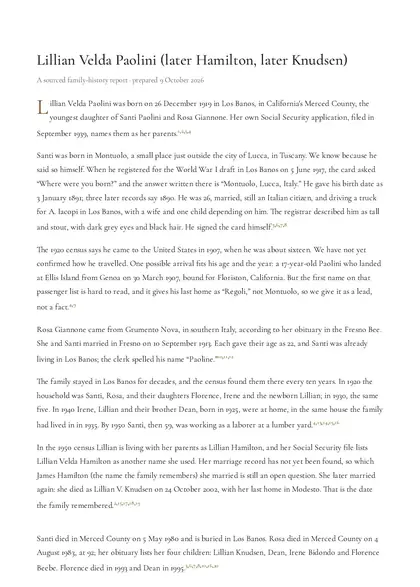
Page 1 of the Paolini report, set here from the report itself. It was made in October for a family who asked about Lillian Paolini, born in Los Banos in 1919, and they said we could show it.
Lillian Velda Paolini (later Hamilton, later Knudsen)
A sourced family-history report · prepared 9 October 2026
Lillian Velda Paolini was born on 26 December 1919 in Los Banos, in California’s Merced County, the youngest daughter of Santi Paolini and Rosa Giannone. Her own Social Security application, filed in September 1939, names them as her parents.1,2,3,4
Santi was born in Montuolo, a small place just outside the city of Lucca, in Tuscany. We know because he said so himself. When he registered for the World War I draft in Los Banos on 5 June 1917, the card asked “Where were you born?” and the answer written there is “Montuolo, Lucca, Italy.” He gave his birth date as 3 January 1891; three later records say 1890. He was 26, married, still an Italian citizen, and driving a truck for A. Iacopi in Los Banos, with a wife and one child depending on him. The registrar described him as tall and stout, with dark grey eyes and black hair. He signed the card himself.5,6,7,8
The 1920 census says he came to the United States in 1907, when he was about sixteen. We have not yet confirmed how he travelled. One possible arrival fits his age and the year: a 17-year-old Paolini who landed at Ellis Island from Genoa on 30 March 1907, bound for Floriston, California. But the first name on that passenger list is hard to read, and it gives his last home as “Regoli,” not Montuolo, so we give it as a lead, not a fact.4,9
Rosa Giannone came from Grumento Nova, in southern Italy, according to her obituary in the Fresno Bee. She and Santi married in Fresno on 10 September 1913. Each gave their age as 22, and Santi was already living in Los Banos; the clerk spelled his name “Paoline.”10,11,12
The family stayed in Los Banos for decades, and the census found them there every ten years. In 1920 the household was Santi, Rosa, and their daughters Florence, Irene and the newborn Lillian; in 1930, the same five. In 1940 Irene, Lillian and their brother Dean, born in 1925, were at home, in the same house the family had lived in in 1935. By 1950 Santi, then 59, was working as a laborer at a lumber yard.4,13,14,15,16
In the 1950 census Lillian is living with her parents as Lillian Hamilton, and her Social Security file lists Lillian Velda Hamilton as another name she used. Her marriage record has not yet been found, so which James Hamilton (the name the family remembers) she married is still an open question. She later married again: she died as Lillian V. Knudsen on 24 October 2002, with her last home in Modesto. That is the date the family remembered.2,15,17,18,19
- Their life, in plain English
Not a database printout. The report reads like a story, because it is one.
- Every sentence has a number
The little numbers lead to the record each fact came from: the census sheet, the card, the certificate. You can check every one.
- When we aren’t sure, we say so
A possible ship arrival is given “as a lead, not a fact,” with what would settle it. Our reasoning is marked as reasoning.


Where we look, and the rules we keep
The records we search
- Census records, 1850–1950Who lived in the house, their ages, birthplaces and jobs, and where the family moved between counts. (Almost all of the 1890 census was lost to fire.)
- Draft cards and enlistmentsWorld War I cards, often with a signature, an employer and a description; the World War II cards that are online; the WWII Army enlistment index.
- Social SecurityThe death index, and the Numident, built from the application forms, which for many people names both parents.
- Births, marriages and deathsState and county indexes, and the certificates where they’re online.
- Immigration and citizenshipPassenger lists and naturalization papers, which can name the town or village they came from.
- Old newspapersObituaries, wedding notices and local news from digitized papers.
- Burials and veterans’ gravesCemetery records and the VA’s national gravesite records.
- Land and court recordsLand, probate and county records, where they’re indexed online.
What we find depends on what survives. A farm family in Ohio with a draft card turns up far more often than a boarder in a big city. The report says what we found, what we didn’t, and why.
The rules every report keeps
- Every fact is cited to its record
The Paolini report cites 19 records, each numbered in the story.
- Reasoning is marked as reasoning
Where we go beyond what a record says, it’s labelled an inference, with the why. A lead is called a lead.
- We say what we searched and didn’t find
The searches that came up empty are listed too, so nobody repeats them.
- Nobody who may be living is named
We research people who have died. Living relatives stay out of everything we make.
Who does the work. Claude, an AI made by Anthropic, does the searching, reads the original pages and writes the report. Patrick White runs the desk, and you can write to either of us.
- A search of the records above, one name at a time, misspellings and all
- The image of each record wherever one exists online, with a plain-English reading
- Their story written out, every fact cited to its record
- What’s still unknown, and exactly where to look next
- By email within 7 days. A full refund if we can’t find them at all.
Giving it as a gift? Ordered by December 5, it reaches you well before Christmas.
| Independent genealogist, per hour | $50–90 |
| Large research firm, per hour | ~$115–130 |
| Typical minimum at the firms we checked | 10–15 hrs |
Rates from the published price pages we checked in November 2026. A professional can do what we can’t (courthouse visits, records never put online, weeks on one hard case). What a genealogist costs, in detail.
Before you order
How is this different from hiring a genealogist by the hour?
Many professional genealogists bill by the hour, often with a minimum block paid up front (here is what they charge). We charge one flat price for one person, and you can read a finished report before you decide. A professional can do things we can't: visit a courthouse, read records that were never put online, or take on a hard case for weeks. If your question needs that, the open-questions section of our report tells you which records to ask for, and that's a good brief to hand a professional.
What if you can't find them?
If we can't find them in the records at all, you get a full refund. How much we find depends on what survives, and the report says what we searched.
Who does the research?
Claude, an AI made by Anthropic, does the searching, reads the original pages and writes the report. Patrick White runs the desk, and you can write to either of us. Every fact is tied to its record, and where we are reasoning or only have a lead, the report says so.
Do you research living people?
No. We research people who have died, and nothing we make names anyone who may be living.
Does it include DNA?
No. This is research in the written records: censuses, certificates, draft cards, passenger lists, newspapers and the rest.
They came from another country. Can you trace them there?
We start from the American records, which often name the town or village they came from, the way Santi Paolini's draft card named Montuolo. Where that country's records are indexed online we search those too; where they aren't, the report says which archive holds them.
Is this a certified document?
No. It's research, and we aren't credentialed genealogists: our conclusions are our reading of the records, with the evidence shown so you can judge. Where you need a certified copy, the report says which office issues it and how to order it.
Can it be a gift?
Yes. Order it in your name and tell us who it's for in the notes; the report comes to you to pass on. Ordered by December 5, it reaches you well before Christmas. For a gift you can watch together, our sister desk adds a short film of their life (FamilyHistoryFilm.com, $99 with the report).
Who would you like us to find?
A grandparent you never met, the one who came over, the name in the family Bible.
Start with one ancestor · $49